How to Promote Your Photography Business in 2026: The Complete Marketing Guide (SEO, AI & Social Media)
If you're still measuring success by the number of Instagram followers you have, you're playing yesterday's game.
For years, photographers were told to post more, chase viral reels, learn the latest Instagram algorithm and hope enough people would eventually book a session.
Some did. Most didn't. Today, the internet works differently.
Search engines are evolving into answer engines. Instead of clicking through ten different websites, people now ask ChatGPT, Google AI Overviews, Gemini, Claude or Perplexity questions like:
Who are the best wedding photographers in Dublin?
How do I choose a family photographer?
What camera settings should I use for sunsets?
How do photographers get clients without Instagram?
Increasingly, these AI tools provide the answer directly. That means your goal is no longer simply to rank on Google.
Your goal is to become one of the sources these AI systems trust enough to cite.
The photographers who adapt early will build authority that compounds over time. Those who continue chasing vanity metrics will find themselves working harder for fewer results.
This guide will show you how to market your photography business in 2026 using a strategy built around:
Social media that attracts the right audience
SEO that still generates long-term visibility
Answer Engine Optimization (AEO) that helps AI platforms reference your expertise
Email marketing that you actually own
AI tools that save hours every week
A marketing system that generates qualified leads instead of just likes
Because the objective isn't more traffic. The objective is better traffic. One qualified visitor who has already seen your name recommended by Google AI or ChatGPT is often worth far more than hundreds of random social media visits.
Let's build a business around that principle.
Why Social Media Alone Is No Longer Enough
There was a time when social media could be your entire marketing strategy. Upload beautiful images. Use thirty hashtags. Post every day. Reply to comments. Grow your followers. Book clients.
Simple.
But today's creators face a different reality. Algorithms change overnight. Organic reach fluctuates dramatically. Platforms prioritise new features. And the audience you spent years building isn't actually yours.
If Instagram disappeared tomorrow, could you still reach your clients? For many photographers, the answer is no.
That's because they've built their business on rented land. Social media is incredibly powerful, but it should be treated as a discovery channel, not your business.
Think of it like this:
Your Instagram profile is your shop window.
Your website is your store.
Your email list is your customer database.
Your reputation is your brand.
These are not the same thing.
The photographers building sustainable businesses understand that every piece of content should move people closer to something they own:
their website
their newsletter
their booking system
their community
Social media attracts attention. Your business converts that attention into revenue.
The Biggest Shift Happening Right Now: From Search Engines to Answer Engines
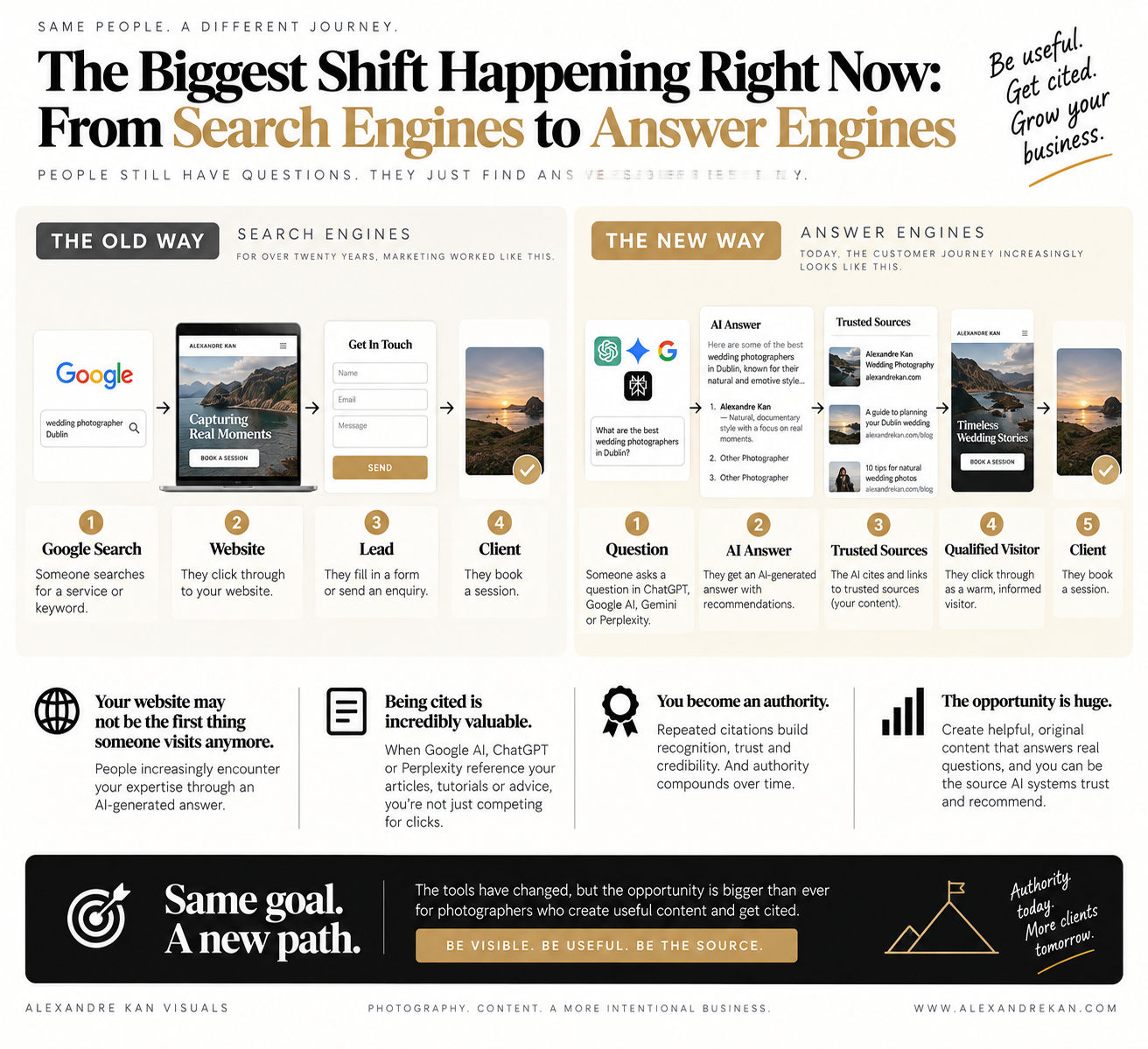
For over twenty years, marketing worked like this:
Google Search → Website → Lead → Client
Now the customer journey increasingly looks like this:
Question → AI Answer → Trusted Sources → Qualified Visitor → Client
Notice something important.
Your website may not be the first thing someone visits anymore. Instead, they first encounter your expertise through an AI-generated answer.
That's why being cited is becoming one of the most valuable forms of online visibility.
When Google AI, ChatGPT or Perplexity repeatedly reference your articles, tutorials or photography advice, you're no longer just competing for clicks.
You're becoming recognised as an authority. And authority compounds.
Traffic Is Becoming a Vanity Metric
Many website owners still celebrate traffic. "Look, I had 50,000 visitors this month!"
But ask the next question:
How many booked a photoshoot?
How many joined the email list?
How many purchased prints?
How many became repeat customers?
Traffic without conversions is simply an expensive hobby. Are you a blogger or a business owner?
Imagine two photographers.
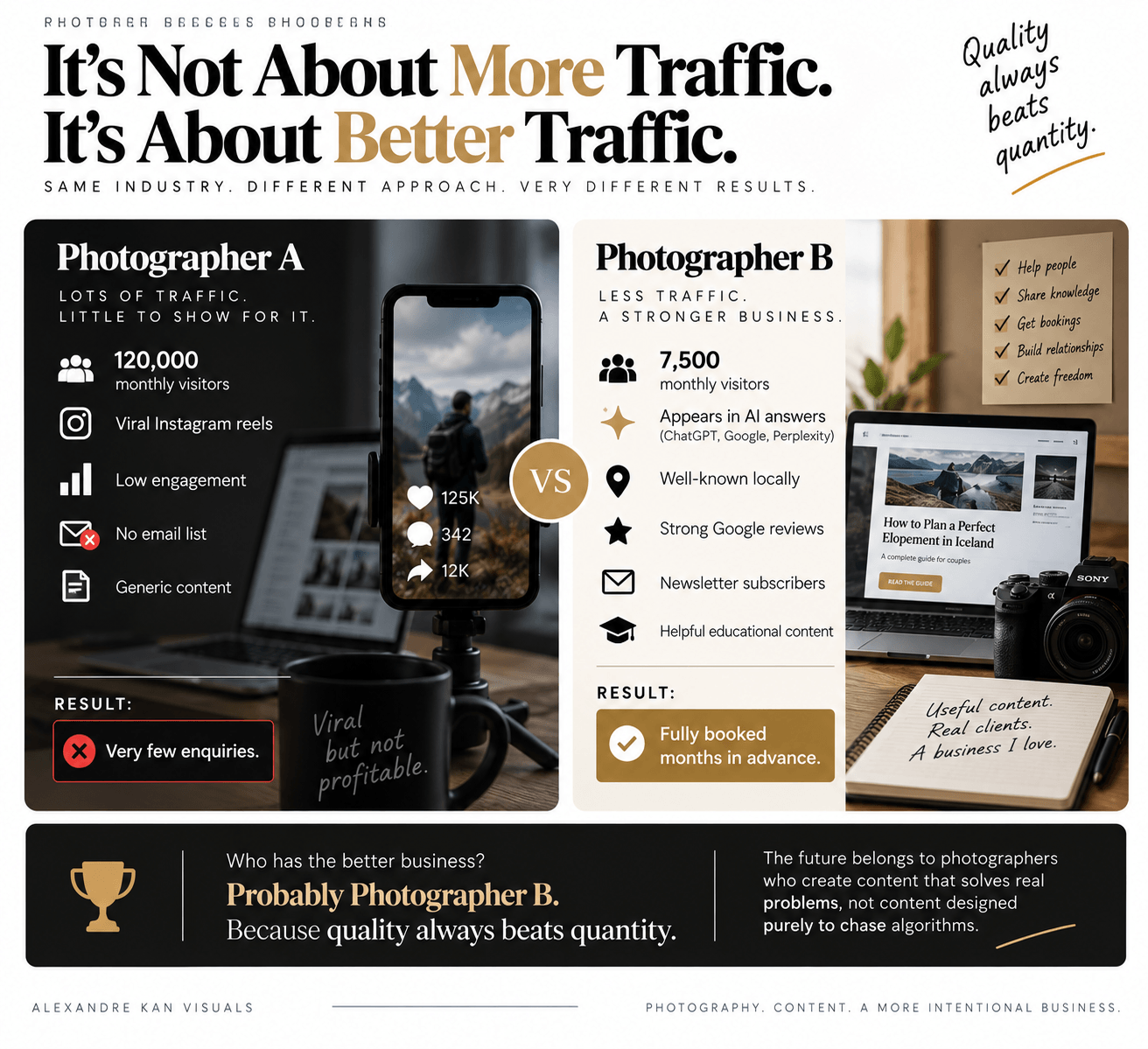
Photographer A
120,000 monthly visitors
Viral Instagram reels
Low engagement
No email list
Generic content
Result: Very few enquiries.
Photographer B
7,500 monthly visitors
Appears in AI answers
Well-known locally
Strong Google reviews
Newsletter subscribers
Helpful educational content
Result: Fully booked months in advance.
Who has the better business?
Probably Photographer B.
Because quality always beats quantity.
The future belongs to photographers who create content that solves real problems, not content designed purely to chase algorithms.
What Is Answer Engine Optimisation (AEO)?
You've probably heard of SEO. Search Engine Optimisation helps your content rank on search engines like Google. AEO, on the other hand, Answer Engine Optimisation, is the practice of creating content that AI systems can easily understand, trust and reference when answering users' questions.
Instead of asking:
"How do I rank #1?"
Ask:
"How do I become the best answer?"
There's an important difference. Good AEO content is:
Accurate
Well-structured
Easy to scan
Clearly written
Backed by experience
Updated regularly
Focused on solving one question at a time
AI models love content that removes ambiguity.
That means using:
descriptive headings
short paragraphs
numbered steps
definitions
comparison tables
FAQs
original insights
first-hand experience
In other words, write for humans first, but make it incredibly easy for machines to understand.
Why Experience Matters More Than Ever
One of the biggest misconceptions about AI is that it only values facts.
In reality, AI systems increasingly prioritise content demonstrating genuine experience.
Anyone can write:
"Golden hour is the best time to take portraits."
That's generic.
Now compare it with this:
During my travels across more than 45 countries, I've learned that golden hour behaves very differently depending on latitude and season. In Iceland, summer sunsets can last for hours, while tropical destinations often offer just a brief window of soft light. Planning around local conditions has consistently produced stronger portraits than relying on generic photography advice.
Which source feels more trustworthy?
Exactly.
Your experiences are becoming one of your biggest competitive advantages because AI can't invent authentic first-hand stories; it can only recognise and reference them when you publish them.
As a photographer, you have something many competitors don't:
client stories
travel experiences
lessons from failed shoots
behind-the-scenes insights
practical workflows
years of editing knowledge
Share those generously. They're what make your content worth citing.
The New Goal: Become the Photographer Everyone References
Instead of asking: "How do I get more followers?"
Ask yourself:
How do I become the photographer people recommend?
How do I become the article Google AI cites?
How do I become the expert ChatGPT references?
How do I publish resources that other creators link to?
How do I answer the questions my ideal clients are already asking?
Because when enough trusted sources begin referencing your work, something powerful happens. You stop chasing attention. Attention starts finding you.
Choosing the Right Platforms & Building Your RevenueOS Content Engine
One of the biggest mistakes photographers make is believing they need to be everywhere.
Instagram.
TikTok.
Pinterest.
Facebook.
Threads.
LinkedIn.
YouTube.
X.
Reddit.
The list keeps growing. Every week there's a new platform promising massive organic reach. But the thing is that trying to master all of them usually leads to burnout.
The photographers building successful businesses in 2026 aren't posting everywhere. They're building one content engine that distributes their expertise across multiple channels.
The difference is enormous. Instead of asking:
"What should I post on Instagram today?"
Ask:
"How can I turn one client session into content that works everywhere?"
That's how you scale your marketing without spending your life creating content.
Think Like a Media Company, Not a Photographer
Your photography business is no longer just a service business.
You're also in the education business.
The storytelling business.
The trust-building business.
The personal branding business.
Every shoot contains dozens of opportunities to create valuable content. For example, imagine you photograph a couple during sunset.
That single session can become:
A portfolio update on your website
An Instagram carousel
A Reel showing behind the scenes
A Pinterest pin linking to your blog
A YouTube Short explaining your lighting setup
A LinkedIn post about managing client expectations
A blog article about choosing the perfect golden-hour location
A newsletter sharing lessons from the shoot
An AI-friendly FAQ answering common client questions
A downloadable location guide for future leads
One photoshoot. Ten pieces of evergreen content. This is called the content waterfall system in marketing. That's leverage.
The RevenueOS Content Flywheel
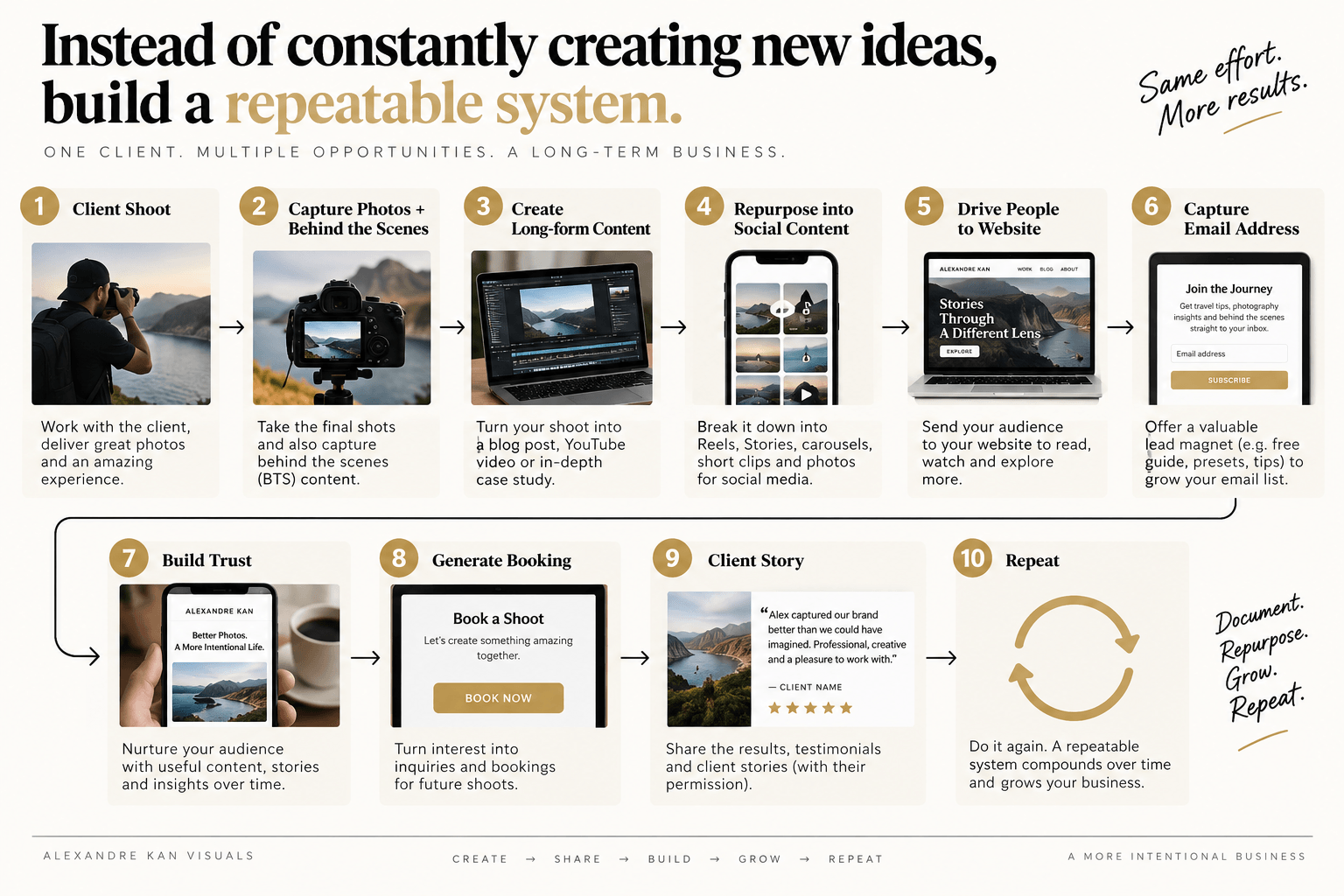
Instead of constantly creating new ideas, build a repeatable system.
Client Shoot Capture Photos + Behind the Scenes → Create Long-form Content → Repurpose into Social Content→ Drive People to Website→ Capture Email Address→ Build Trust→ Generate Booking→ Client Story→ Repeat Notice what sits at the centre. Not Instagram. Not TikTok.
Your expertise.
Platforms change. Authority lasts.
Which Platforms Should Photographers Focus On?
Not every platform serves the same purpose.
Each one plays a different role in your marketing ecosystem.
Let's break them down.
Instagram: Your Visual Portfolio
Instagram is still one of the best platforms for photographers. But its role has changed.
It's no longer just about showcasing beautiful images. People want authenticity. Education. Personality. Behind-the-scenes moments.
The photographers growing today are showing how they create, not just what they create.
What works well:
Carousel posts explaining your process
Before-and-after edits
Behind-the-scenes Reels
Client stories
Tips and tutorials
Location guides
Personal experiences
What doesn't work as well anymore:
Posting only finished images
Generic motivational quotes
Hashtag stuffing
Engagement pods
Buying followers
Instagram should introduce people to your brand, not be your entire business.
Pinterest: The Most Underrated Traffic Source
Pinterest is often misunderstood. It's not really a social network. It's a visual search engine. I wrote a few guides you can find below if you wish to deep dive.

People go to Pinterest looking for ideas. That means they already have intent.
Someone searching:
Wedding photography poses
Iceland photography locations
Family photoshoot inspiration
Lightroom presets
Travel photography tips
is much closer to becoming a client than someone mindlessly scrolling Instagram. Pins also have an incredibly long lifespan. An Instagram post might disappear within 24 hours. A Pinterest pin can generate traffic for years.
For photographers who enjoy blogging, Pinterest remains one of the highest-leverage platforms available. Up until today, Pinterest has contributed to 60% of my website's overall traffic.
LinkedIn: The Hidden Opportunity
Many photographers dismiss LinkedIn because they think it's only for recruiters and office workers.
That's a mistake.
LinkedIn has become one of the best platforms for attracting premium commercial work. Think about who hires photographers:
Marketing managers
CEOs
Startup founders
Event organisers
Tourism boards
Hotels
SaaS companies
Personal brands
They're already spending time on LinkedIn. Instead of posting only finished images, share insights like:
What makes a brand photoshoot successful
Behind the scenes of commercial projects
Lessons learned working with clients
Travel stories
Marketing advice
Creative process
You're no longer competing with thousands of photographers. You're building authority among decision-makers.
YouTube: The Trust Machine
Nothing builds trust faster than video. People don't just see your work.
They get to know you. Even simple videos can establish credibility:
Editing walkthroughs
Gear reviews
Client shoots
Travel documentaries
Photography tutorials
Mistakes you've learned from
Location guides
Long-form YouTube videos also continue generating views years after publication. Unlike most social platforms, YouTube content compounds. It's an investment rather than a daily obligation. If you want to follow that path and need some guidance, I’d recommend you to join the Lost Creator Academy led by Christian Leblanc, a professional youtuber with more than 25 million subscribers who breaks down his entire business and creative workflows inside his academy. You can read my complete review here.
Short-Form Video: Reach at Scale
Short-form content remains one of the fastest ways to reach new audiences.
That includes:
Instagram Reels
YouTube Shorts
TikTok
Instead of chasing trends, focus on educational micro-content.
Examples:
"Three posing mistakes couples always make."
"Why cloudy days are perfect for portraits."
"How I edited this photo in under two minutes."
"The lens I use for 90% of my travel photography."
Simple. Practical. Helpful.
AI platforms also increasingly reference video transcripts, making educational videos valuable for both human viewers and answer engines.
Facebook: Still Useful, But Differently
Facebook isn't dead. Its purpose has simply changed.
Instead of relying on organic page reach, photographers can use Facebook for:
Local community groups
Business networking
Marketplace visibility
Client referrals
Paid advertising
Testimonials
For many local photographers, neighbourhood Facebook groups remain one of the easiest places to generate enquiries.
Threads: Build Conversations, Not Campaigns
This is the social media platform that still remains authentic for now, in my opinion and is really appreciated by millennials. It is still not too spammy with ads. Threads rewards genuine interaction more than polished content. Think of it as your public notebook.
Share:
Photography lessons
Client experiences
Industry opinions
Travel observations
Creative challenges
Business insights
Many photographers overthink Threads. You don't need perfect photos. Just valuable ideas.
Your Website Is Still Your Most Important Asset
Here's something many creators forget. Every platform is borrowed. Your website is owned.
Algorithms change. Your website doesn't.
Platforms disappear. Your website remains.
Follower counts fluctuate. Your website keeps collecting leads.
That's why every platform should point back to your own ecosystem.
Your website should become the central hub for:
Portfolio
Blog
Resources
Booking information
Testimonials
Email newsletter
Products
Courses
Workshops
The website is where attention becomes opportunity.
Create Content That AI Wants to Reference
Answer engines don't cite content because it's beautiful.
They cite it because it's useful.
Every article you publish should answer real questions your ideal clients ask.
Examples include:
How much should wedding photography cost?
What should I wear for a family photoshoot?
What camera settings should beginners use?
How do photographers edit skin naturally?
What should I pack for travel photography?
Each question becomes an opportunity to build authority. Rather than writing one massive article covering everything, create clusters of focused content that answer specific questions in depth.
This makes your expertise easier for both search engines and AI systems to understand.
The Best Content Is Experience-Based
Anyone can summarise photography tips found online. Few people can share stories only they have lived.
If you've photographed a wedding in stormy weather, explain what happened. If you've travelled to remote landscapes, describe what you learned.
If you've made mistakes, document them.
Those experiences create originality, and originality is increasingly what sets your content apart in an AI-driven world.
Instead of asking:
"What can I post today?"
Ask:
"What have I experienced that someone else could learn from?"
That's the content that earns trust.
Your Goal Isn't to Go “Viral”
Sure, virality is exciting. But authority is profitable.
A single educational article that answers a common client question can generate leads for years.
A viral Reel might be forgotten by next week. Focus on creating assets rather than moments.
Every blog post.
Every tutorial.
Every guide.
Every FAQ.
Every case study.
Every client story.
These become pieces of intellectual property that continue working long after you've published them.
Think less like an influencer. Think more like a publisher.
SEO + AEO for Photographers: How to Become the Source AI Recommends
If the first decade of digital marketing was about ranking, the next decade is about being referenced.
That's a subtle but important shift.
For years, photographers focused on one question:
"How do I get my website to rank #1 on Google?"
Today, the better question is:
"How do I become the most trusted answer, regardless of where people search?"
Whether someone searches on Google, asks ChatGPT, uses Gemini, Claude, Perplexity or another AI assistant, the goal remains the same:
Become the photographer whose expertise gets recommended.
This is where SEO (Search Engine Optimisation) and AEO (Answer Engine Optimisation) work together.
SEO helps people discover your website. AEO helps AI discover your expertise.
Master both, and your content becomes an asset that keeps attracting qualified clients long after you hit publish.
SEO Isn't Dead, It's Evolving
Every few years, someone declares SEO dead.
First it was social media. Then voice search. Now AI.
The reality is much simpler.
SEO isn't disappearing. It's evolving. Search engines still need high-quality information to answer questions.
The difference is that users may never click through ten blue links anymore. Instead, they'll often receive a synthesised answer generated from multiple trusted sources.
Your objective is no longer just to appear in the search results. It's to be one of the sources that shapes the answer.
Introducing the "Trust Pyramid"
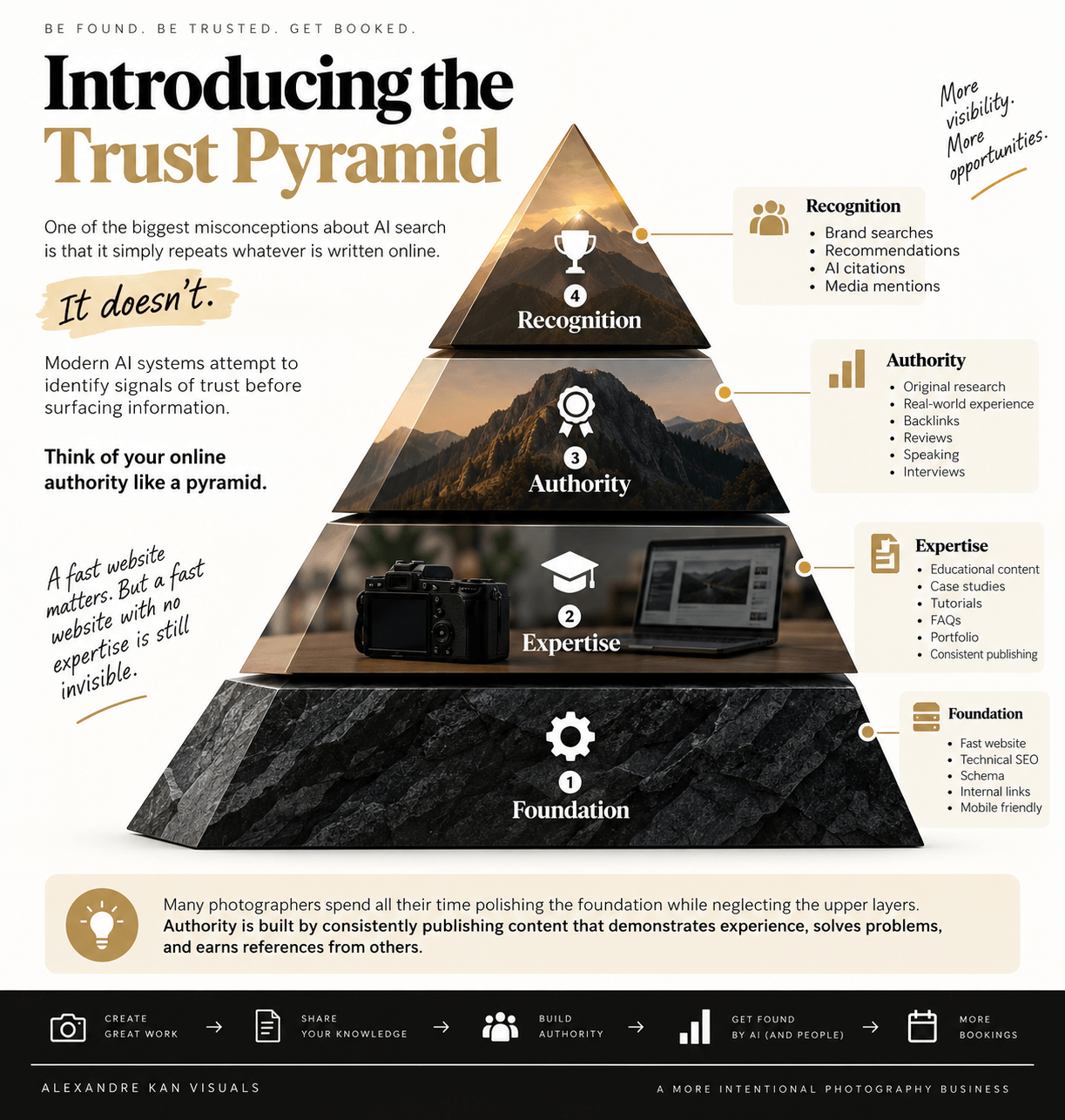
One of the biggest misconceptions about AI search is that it simply repeats whatever is written online.
It doesn't.
Modern AI systems attempt to identify signals of trust before surfacing information.
Think of your online authority like a pyramid.
Recognition (Brand searches, recommendations, AI citations, media mentions)
Authority (Original research, experience, backlinks, reviews, speaking, interviews)
Expertise (Educational content, case studies, tutorials, FAQs, portfolio, consistent publishing)
Foundation (Fast website, technical SEO, schema, internal links, mobile friendly)
Many photographers spend all their time polishing the foundation while neglecting the upper layers.
A fast website matters. But a fast website with no expertise is still invisible.
Authority is built by consistently publishing content that demonstrates experience, solves problems, and earns references from others.
Write for Questions, Not Keywords
Traditional SEO often began with keyword research.
Find a phrase. Write an article. Repeat.
That still has value, but AEO starts somewhere else.
It starts with questions.
Think about every question you've answered from clients over the past year.
Examples include:
What should I wear for my engagement shoot?
How long does a family session last?
Should we choose sunrise or sunset?
Can you photograph in the rain?
How far in advance should I book?
Every one of those questions deserves its own answer. Not because you're trying to rank for a keyword.
Because real people, and AI systems, are looking for those answers.
This approach naturally creates content that aligns with how modern search works.
The Best Photography Websites Become Libraries
Imagine someone lands on your website after asking:
"How do I prepare for a maternity photoshoot?"
They read your article. Then they discover:
What to wear
Best locations
Best time of day
How to prepare children
Frequently asked questions
Related articles
Client examples
Instead of answering one question, your website answers the next ten.
That's how you build topical authority. Google doesn't just rank pages. It evaluates websites.
The more comprehensive your content around a topic, the more likely search engines and AI systems are to view you as an expert.
Topical Authority Beats Viral Content
One viral Instagram Reel might bring you 500,000 views.
That's exciting.
But what happens next week?
Probably very little.
Now imagine publishing fifty in-depth articles answering every question a potential client could have before booking you.
Over time, those articles begin to reinforce each other. Search engines understand that your website isn't about photography in general.
It's about your specific area of expertise. For example, a travel photographer might create content around:
Travel photography gear
Mobile photography
Drone photography
Editing workflows
Destination guides
Photography business advice
Each article strengthens the others. Instead of isolated pieces of content, you build an interconnected knowledge base.
Create Pillar Content and Supporting Articles
Think of your content like a tree. The trunk is your pillar guide. The branches are supporting articles.
For example:
The Complete Guide to Growing a Photography Business
Supporting articles might include:
How to Price Your Photography Services
How to Find Photography Clients
Photography Contracts Explained
Best CRM Software for Photographers
How to Create a Photography Portfolio
Instagram Marketing for Photographers
Pinterest for Photographers
AI Tools Every Photographer Should Know
Email Marketing for Photographers
Each supporting article links back to the pillar guide. The pillar guide links to every supporting article.
This internal linking structure helps both users and search engines understand the relationships between topics.
It's also one of the clearest signals of topical authority.
Write Like You're Teaching a Friend
Many photographers try to sound "professional." Unfortunately, professional often becomes robotic.
AI doesn't reward jargon. People don't either.
Instead, write as if you're explaining photography to a friend over coffee.
Use simple language. Break complex ideas into steps. Provide examples. Tell stories.
Remember:
People don't trust websites. People trust people.
Your personality is an advantage, not a distraction.
Original Experience Is Your Greatest SEO Advantage
The internet doesn't need another generic article listing "10 Photography Tips."
AI can generate that in seconds. What AI can't replicate is your lived experience.
For example:
Instead of saying:
Always scout locations before a photoshoot.
Explain how you once arrived at a beautiful location only to discover construction fencing around your planned backdrop, and how that experience changed your preparation process forever.
Those stories create originality. Originality creates trust. Trust creates authority. Authority leads to citations.
The Anatomy of an AI-Friendly Article
Every article you publish should make it incredibly easy for humans and machines to understand.
A strong structure might look like this:
Answer the main question immediately.
Explain why it matters.
Break the topic into logical sections.
Use descriptive headings.
Include numbered steps where appropriate.
Add examples from your own experience.
Link to related articles.
Finish with a concise summary.
Include frequently asked questions.
This structure isn't just good for SEO. It's good writing.
Why FAQs Matter More Than Ever
AI assistants often extract concise answers from FAQ sections because they're structured around natural language.
Instead of guessing what people want to know, answer the questions they're already asking.
For example:
How often should photographers post on Instagram?
Quality matters more than quantity. Posting consistently once or twice a week while providing educational and engaging content is generally more effective than posting daily without a clear strategy.
Should photographers still blog?
I wrote a complete article that you can find below to help you get started if that’s something you are interested in learning more about.
Yes. A blog allows you to build topical authority, answer client questions, improve your visibility in search engines, and create content that AI systems can reference.
What's more important: followers or email subscribers?
Email subscribers. You own your email list, while your social media audience is subject to changing platform algorithms and policies.
Notice how each answer is short, direct, and self-contained. That's exactly the type of content AI systems can easily understand.
Add Statistics Carefully
Data builds credibility, but only when it's accurate and relevant. Rather than filling your articles with random statistics, use them to support a key point.
Better yet, create your own.
For example:
Average delivery time across your last 100 clients.
Percentage of enquiries that came from referrals.
Most popular photography locations you've used.
Favourite focal lengths for different scenarios.
Before-and-after editing examples.
Original data is far more valuable than repeating numbers everyone else has already cited. Don't Just Publish, Refresh.
One of the easiest SEO wins is updating existing content. Instead of writing 100 new articles every year, revisit your best-performing posts.
Update:
Screenshots
AI tools
Statistics
Internal links
FAQs
New experiences
Recent examples
Search engines and readers prefer content that reflects the current landscape. This article itself is an example of that principle.
Build a Brand AI Can Recognise
Here's a concept that many marketers still overlook. AI doesn't just learn from pages. It learns from patterns.
If your name consistently appears alongside topics like:
photography business
mobile photography
travel photography
creator monetization
AI workflows
Those associations become stronger over time. That's why consistency matters. Rather than writing about everything, become known for something.
Specialisation builds memorability. Memorability builds authority. Authority leads to recommendations.
Stop Creating Content. Start Building Assets.
Every article should continue working for you years after publication.
Ask yourself before writing:
Will this still be useful in three years?
Does it solve a real problem?
Is it based on my experience?
Would I proudly send this to a paying client?
Could an AI confidently quote this?
If the answer is yes, you've created an asset, not just another blog post. That's how photographers build businesses that grow steadily instead of constantly chasing the next algorithm update.
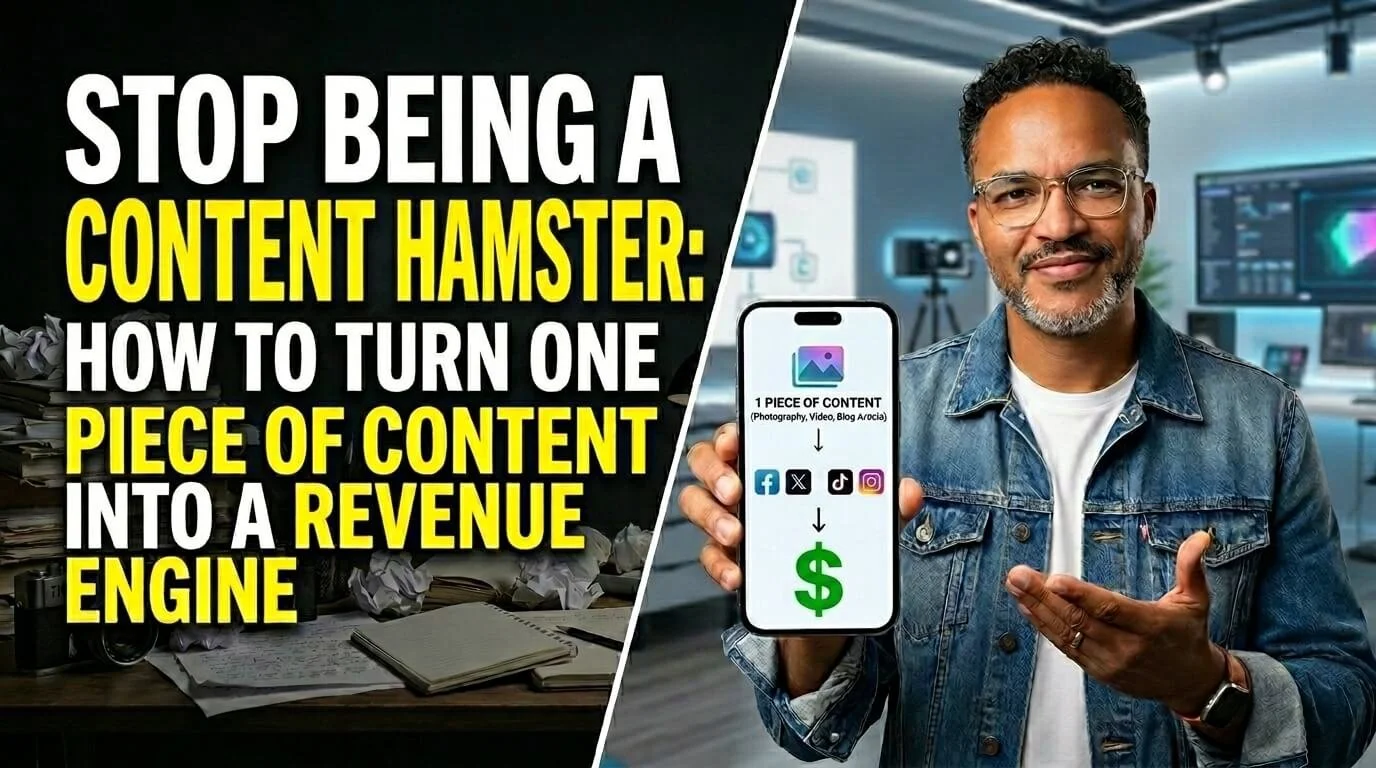
Stop being a content hamster wheel. I wrote a complete guide on how to turn one piece of content into a revenue engine.
Turning Attention into Revenue: Build a Photography Business That Doesn't Depend on Algorithms
You've now learned:
Why AI is changing how people discover photographers.
Why authority matters more than traffic.
How SEO and AEO work together.
Which platforms deserve your attention.
Now comes the most important part. Because visibility alone doesn't pay the bills. Revenue does.
The photographers who thrive over the next decade won't necessarily be the ones with the biggest audience.
They'll be the ones with the best Revenue Operating System.
Stop Building a Social Media Strategy. Start Building a Business System.
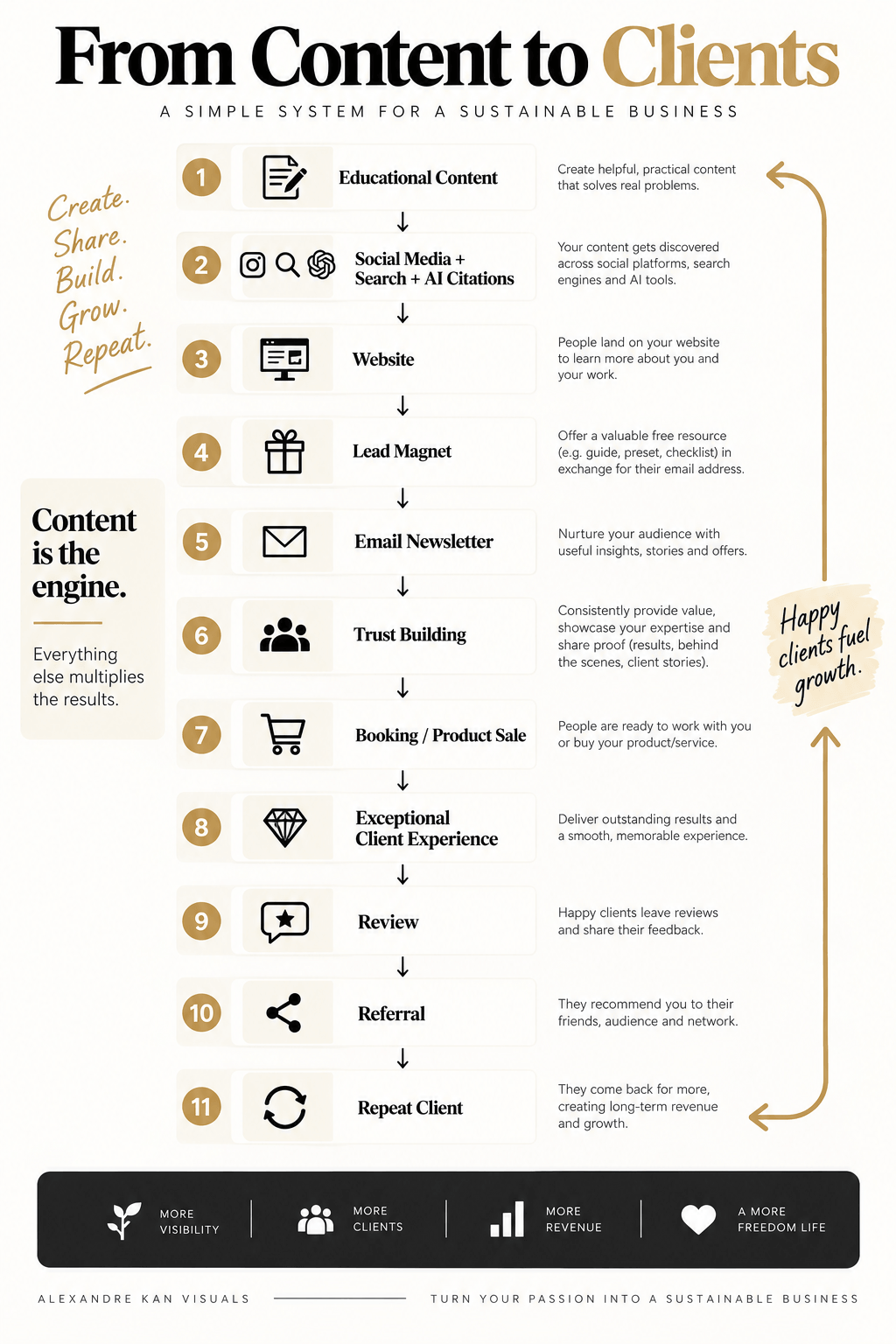
Many photographers think marketing looks like this:
Post Photo > Get Likes >Hopefully Someone Books
It's unpredictable. There's no system. No repeatability. No way to forecast revenue.
Instead, your business should operate like this:
Educational Content > Social Media + Search + AI Citations > Website > Lead Magnet > Email Newsletter >Trust Building > Booking / Product Sale ↓ Exceptional Client Experience > Review > Referral > Repeat Client
Notice something important. Social media is only one step. Not the destination.
Every Piece of Content Should Have One Job
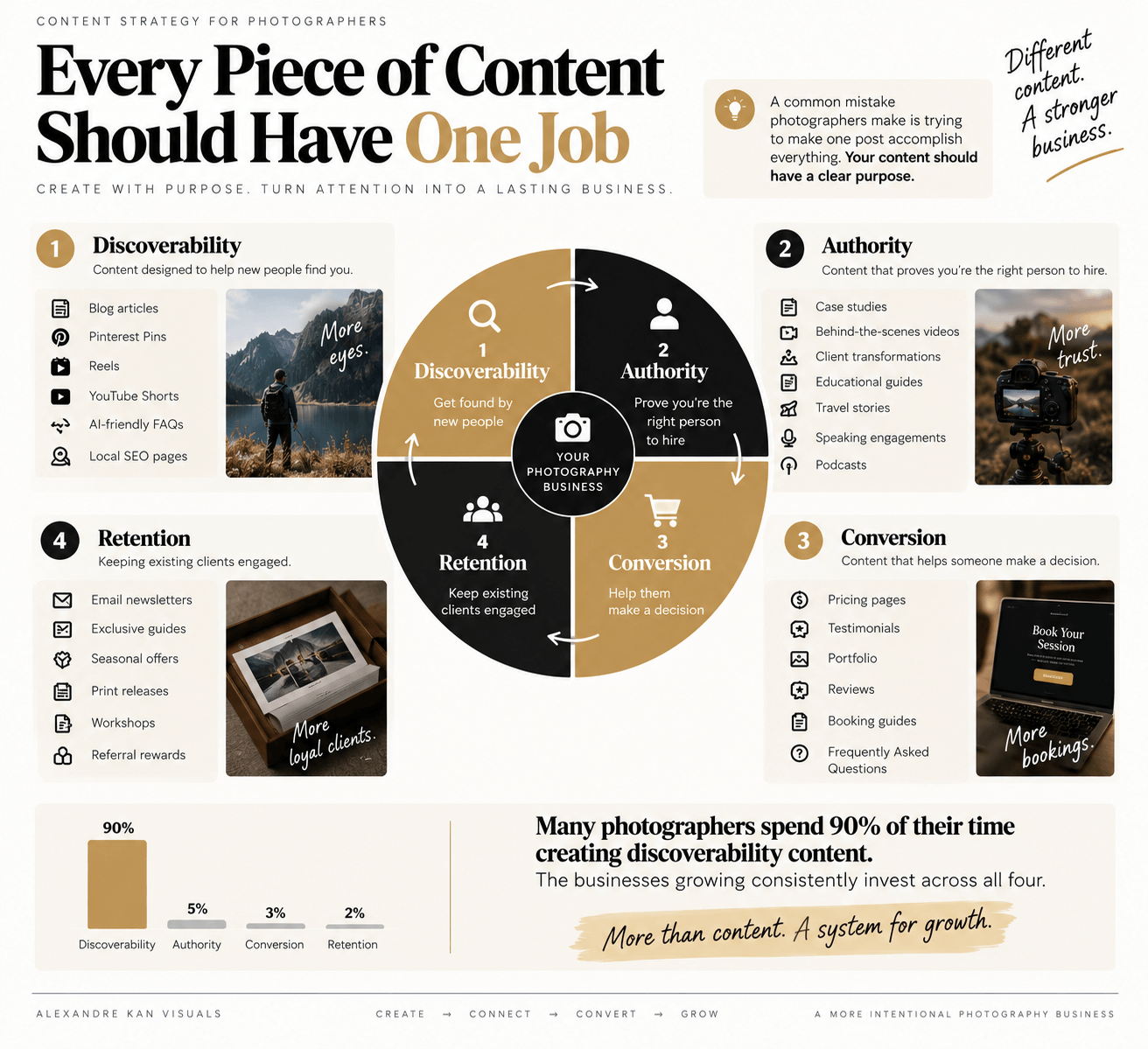
A common mistake photographers make is trying to make one post accomplish everything.
Your content should have a clear purpose. Think of your marketing in four categories.
1. Discoverability
Content designed to help new people find you.
Examples:
Blog articles
Pinterest Pins
Reels
YouTube Shorts
AI-friendly FAQs
Local SEO pages
2. Authority
Content that proves you're the right person to hire.
Examples:
Case studies
Behind-the-scenes videos
Client transformations
Educational guides
Travel stories
Speaking engagements
Podcasts
3. Conversion
Content that helps someone make a decision.
Examples:
Pricing pages
Testimonials
Portfolio
Reviews
Booking guides
Frequently Asked Questions
4. Retention
Keeping existing clients engaged.
Examples:
Email newsletters
Exclusive guides
Seasonal offers
Print releases
Workshops
Referral rewards
Many photographers spend 90% of their time creating discoverability content.
The businesses growing consistently invest across all four.
Why Email Is Becoming More Valuable Every Year
Algorithms decide who sees your posts. You decide who receives your emails.
That's a massive difference. Your email list is one of the few marketing assets you truly own.
Imagine waking up tomorrow to find your Instagram account suspended.
Could you still reach your audience?
If not, your business is more fragile than you think. Every photographer should offer something genuinely useful in exchange for an email address.
Ideas include:
What to Wear Guide
Family Photoshoot Checklist
Wedding Photography Timeline
Travel Photography Packing List
Lightroom Presets
Photography Location Guide
Mobile Photography Starter Guide
These resources solve a real problem while introducing potential clients to your expertise.
Your Newsletter Should Educate, Not Just Sell
Nobody enjoys receiving constant sales emails.
Instead, become the photographer whose newsletter people look forward to reading.
A simple framework could be:
One lesson you've learned recently.
One photo and the story behind it.
One helpful photography tip.
One recommendation (gear, book, location, app).
One invitation to work with you.
Over time, this builds familiarity. And people buy from photographers they know and trust.
AI Won't Replace Great Photographers. It Will Replace Inefficient Workflows.
There's a lot of fear surrounding AI. The reality is more nuanced.
Clients don't hire photographers because they can't generate an image.
They hire photographers because they want:
Authentic moments.
Human connection.
Professional guidance.
Real experiences.
Confidence.
Consistent results.
Where AI shines is behind the scenes. It removes repetitive work. That gives you more time to create.
My Recommended AI Stack for Photographers in 2026
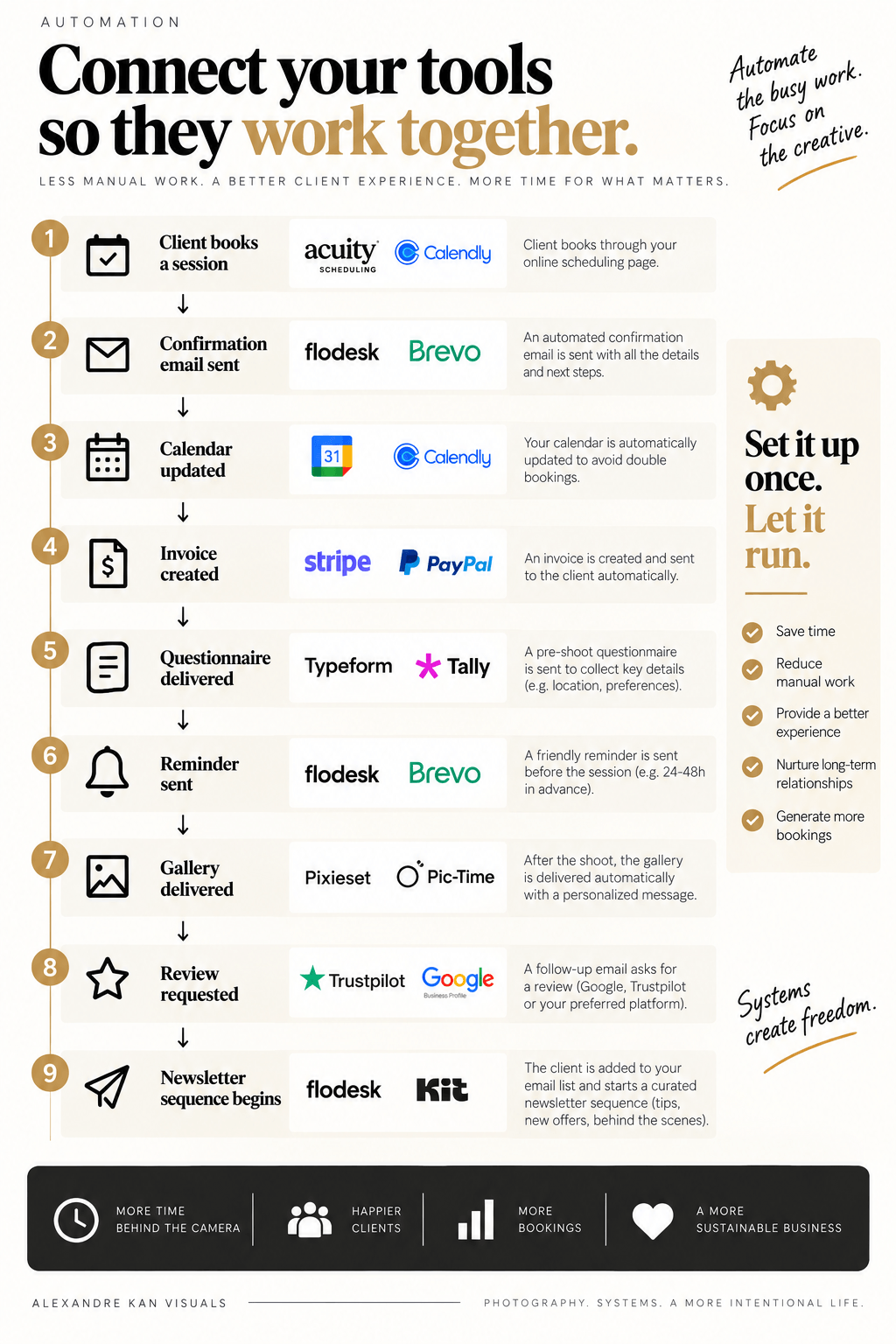
Technology evolves quickly, but the principle stays the same: use AI to eliminate repetitive tasks so you can spend more time behind the camera and with clients.
Research
Use AI to:
Brainstorm blog ideas.
Discover client questions.
Generate content briefs.
Analyse competitors.
Identify trending topics.
Writing
Use AI for:
First drafts.
Social captions.
Email sequences.
YouTube descriptions.
FAQs.
Meta descriptions.
Always edit with your own voice and experience.
Editing
AI can help with:
Subject selection.
Background removal.
Object cleanup.
Noise reduction.
Colour matching.
Culling thousands of photos.
Automation
Connect your tools so they work together.
For example:
Client books a session
↓
Confirmation email sent
↓
Calendar updated
↓
Invoice created
↓
Questionnaire delivered
↓
Reminder sent
↓
Gallery delivered
↓
Review requested
↓
Newsletter sequence begins
Automation doesn't remove the personal touch. It removes the repetitive administration surrounding it.
Measure the Metrics That Actually Matter
Likes are easy to measure. Revenue is what matters.
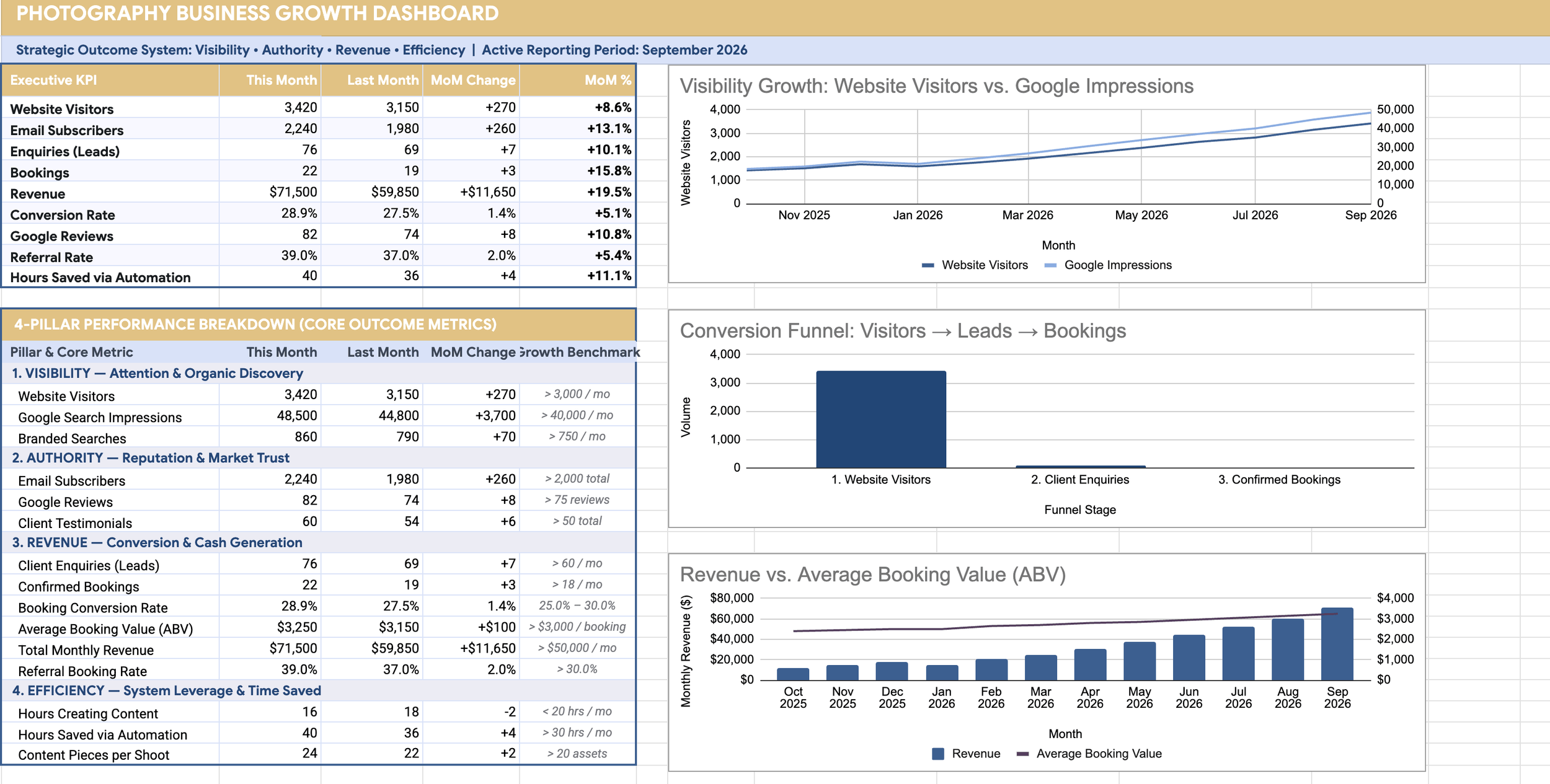
Instead of obsessing over vanity metrics, build a dashboard around business outcomes.
Track:
Visibility
Branded searches
AI citations
Google impressions
Pinterest impressions
YouTube views
Authority
Newsletter subscribers
Backlinks
Reviews
Podcast invitations
Mentions
Speaking opportunities
Revenue
Monthly enquiries
Booking conversion rate
Average booking value
Customer lifetime value
Referral rate
Repeat bookings
Efficiency
Hours spent creating content
Hours saved through automation
Content pieces created from each photoshoot
The objective isn't to become busier.
It's to become more effective.
I created a free dashboard template that you can get access to via the button below to help you get started.
The Biggest Mistakes Photographers Still Make
After working in digital marketing since 2013 and helping creators grow online, I've noticed the same patterns again and again.
Chasing Every New Platform
You don't need to be everywhere. You need to be consistently valuable somewhere.
Posting Without a Goal
Every piece of content should move someone one step closer to becoming a client.
If it doesn't, ask why you're creating it.
Ignoring Their Website
Social platforms are rented. Your website is owned. Never forget the difference.
Only Showing Finished Photos
People love seeing the process. Show your planning.
Your mistakes. Your edits.
Your client interactions. Your thinking.
Trust is built behind the scenes.
Waiting for Perfect
Your first article won't be perfect. Neither will your first video.
Publish. Learn. Improve. Consistency compounds.
That’s how Fortune 500 companies work. Iteration is key to improvement and collecting market feedback.
One of the mottos from Facebook used to be “Move Fast And Break Things”, another way of saying “better ask for forgiveness than for permission”.
You need to try new things and publish as soon as possible to get market feedback and judge if it is the right call or not.
The 90-Day Action Plan
If you're starting today, don't try to do everything at once.
Here's a practical roadmap.
Month 1: Build Your Foundation
Audit your website.
Update your portfolio.
Optimise your Google Business Profile.
Start collecting testimonials.
Publish one in-depth pillar article.
Create a lead magnet.
Set up an email newsletter.
Month 2: Build Authority
Publish four supporting blog posts.
Repurpose them into social content.
Create your first YouTube video.
Start posting consistently on LinkedIn.
Create Pinterest pins for every article.
Answer client questions through content.
Month 3:Build Your Revenue Engine
Automate your enquiry process.
Launch a newsletter.
Create a downloadable resource.
Improve your booking journey.
Review your analytics.
Double down on what works.
After ninety days, you'll have built assets that continue generating value long after they're published.
Final Thoughts: Build a Brand Worth Remembering
The internet is entering a new era.
An era where artificial intelligence helps people discover information faster than ever before.
Some photographers see this as a threat. I see it as an opportunity.
Because AI doesn't eliminate expertise, it amplifies it.
The photographers who consistently share their knowledge, document their experiences, answer real questions, and help people solve problems will become the trusted voices that search engines, answer engines, and potential clients return to again and again.
Don't measure your success by follower counts. Measure it by the trust you've earned.
By the people you've helped. By the reputation you've built.
By the systems you've created. And by the freedom your business gives you.
At the end of the day, your goal isn't to become the most famous photographer on the internet.
It's to become the photographer people think of first when they need someone they can trust.
That kind of reputation can't be hacked. It can't be automated.
And unlike algorithms, it doesn't disappear with the next platform update.
Frequently Asked Questions
Is social media still worth it for photographers in 2026?
Absolutely. Social media remains one of the best discovery channels for photographers. The key difference is that it should work alongside your website, email list, and AI-optimized content rather than replacing them.
What is more important: SEO or AEO?
They complement each other. SEO helps your content appear in traditional search results, while AEO increases the chances of your expertise being referenced by AI-powered search experiences. Together, they create a stronger long-term visibility strategy.
How can photographers increase their chances of being cited by AI?
Publish original, experience-based content that answers specific questions clearly. Use descriptive headings, concise explanations, FAQs, and regularly update your articles. AI systems are more likely to reference trustworthy, well-structured, and comprehensive resources.
Should I focus on getting more website traffic?
Not necessarily. Qualified traffic is far more valuable than large volumes of untargeted visitors. A smaller audience actively looking for your services will almost always generate better business results than viral content with no commercial intent.
What's the best marketing investment for a new photographer?
Start with the assets you own: a professional website, a Google Business Profile, an email newsletter, and a content strategy built around answering your ideal clients' questions. These continue generating value long after social posts have disappeared from people's feeds.
What's Stopping Your Photography Business from Growing?
You've just learned how the most successful photographers are adapting to an AI-first world.
But here's the truth:
Most photography businesses don't struggle because they take bad photos. They struggle because they have hidden revenue leaks.
Maybe you're attracting plenty of visitors but very few enquiries.
Maybe your social media is generating likes but not bookings.
Maybe your website isn't converting visitors into clients.
Or perhaps you're spending hours creating content without a predictable system that turns attention into revenue.
The good news? Every one of these problems can be identified and fixed.
Take the Content to Revenue Quiz
In less than 3 minutes, you'll discover:
Where your biggest business leak is
Which stage of your marketing funnel needs attention
Why your content isn't generating consistent enquiries
What to focus on next to increase your bookings
Your personalised RevenueOS roadmap
Whether you're just starting your photography business or looking to scale an established brand, this free assessment will help you identify the fastest path to predictable growth.
👉 Take the free Content to Revenue Quiz and uncover your biggest revenue leak today.
One final thought...
The photographers who thrive over the next decade won't necessarily be the most talented. They'll be the ones who build systems instead of relying on algorithms.
Stop asking:
"How do I get more followers?"
Start asking:
"How do I build a business that generates predictable revenue, no matter how the internet changes?"
That's the difference between being a successful photographer and building a successful photography business.
I hope this guide helps you do both. To your success!


PIN ME


Using Pinterest but need more traffic for your website? Start Marketing your business with Tailwind app. Here is how.This article breaks down the benefits of using Tailwind app which allows you to automate the pinning process and bring more visitors to your website effortlessly